
Master the Engagement Assessment Matrix: Uses, Examples, and Why It Matters
Why Stakeholder Engagement Can Make or Break Your Mission

An engagement assessment matrix is a project management tool that helps you track where each stakeholder stands—from unaware to actively championing your work—so you can close gaps and build the support your mission needs to succeed.
Quick Overview: What You Need to Know
- What it is: A visual grid that maps stakeholders against five engagement levels (Unaware, Resistant, Neutral, Supportive, Leading)
- What it tracks: Current engagement (C) vs. Desired engagement (D) for each stakeholder
- Why it matters: Identifies gaps in support, guides communication strategy, and helps allocate resources effectively
- When to use it: During project planning, at key milestones, and whenever stakeholder dynamics shift
- Primary benefit: Turns engagement from guesswork into strategic action
For any purpose-driven organization, a mission fails without the right people behind it. A clear vision isn't enough if funders are neutral, community leaders are unaware, or teams are resistant. Your project can stall before it even starts.
That's where the engagement assessment matrix comes in. This framework—rooted in the Project Management Body of Knowledge (PMBOK)—gives you a simple, visual way to see who supports your work, who doesn't, and what it takes to move them. It's not about manipulation. It's about clarity, strategy, and respect for the people whose buy-in you need.
The challenge many leaders face isn't a lack of passion or expertise. It's a lack of structured insight into where stakeholders actually stand versus where they need to be. You might assume your board is fully supportive, only to find they're neutral when it's time to approve funding. Or you might overlook a community partner who could become a champion with just a little more engagement.
This guide walks you through how to build and use an engagement assessment matrix—step by step—so you can make smarter decisions, communicate more effectively, and drive your mission forward with confidence.
I'm Jason R.L Wallace, and for over 15 years, I've helped federal agencies, nonprofits, and municipal leaders build strategic engagement frameworks. I rely on tools like the engagement assessment matrix to turn complex stakeholder landscapes into actionable plans that deliver real results.
What Is a Stakeholder Engagement Assessment Matrix?
A stakeholder engagement assessment matrix is a project management tool that provides a clear, visual representation of the current and desired engagement levels of your stakeholders. Its primary purpose is to help align project deliverables and dependencies so you can move through planned steps with minimal friction. It offers a structured way to analyze and prioritize the individuals or groups involved in a project, allowing you to understand their level of influence, interest, and impact on your mission's outcomes.
This matrix is specified in the Project Management Body of Knowledge (PMBOK) as part of the Plan Stakeholder Management process. It is integral to planning and monitoring communications and stakeholder engagement. By classifying stakeholders' current (C) and desired (D) status, the matrix helps track buy-in, which is critical for purpose-driven organizations in areas like Oxon Hill, Maryland, Washington DC, Alexandria VA, and Fort Washington.
At its heart, the engagement assessment matrix helps you visualize where your stakeholders are today and where you need them to be for your project to thrive. This clarity is invaluable for tailoring communication, allocating resources effectively, and ensuring that your mission resonates with everyone who has a stake in its success.
The Key Components of the Matrix
To get real value from the engagement assessment matrix, it helps to understand its fundamental building blocks:
- Stakeholders: Individuals or groups with a vested interest in your project, such as board members, staff, funders, or community leaders. They are listed in the matrix rows and represent the "who" of your strategy.
- Engagement Levels: Predefined categories describing a stakeholder's stance toward the project. These form the matrix columns and provide a standard way to assess and compare stakeholder positions.
- Current Engagement (C): For each stakeholder, you mark their existing level of involvement or support with a "C." This is your baseline, representing where they currently stand. Determining this requires careful observation, direct feedback, and an honest assessment of their actions and attitudes.
- Desired Engagement (D): For each stakeholder, you also identify their ideal level of involvement or support for the project's success, marking it with a "D." This is your target, reflecting where you need them to be. The "D" helps set realistic goals and align engagement efforts with overall project objectives.
- Identifying Gaps: The value of the matrix appears when you compare the "C" and "D" for each stakeholder. The difference between these two points highlights the engagement gap. A gap indicates a discrepancy between where a stakeholder is and where you need them to be, signaling an area that requires focused attention and strategic intervention.
- Action Planning: Once these gaps are identified, the matrix guides your action planning. It helps you formulate specific strategies to move stakeholders from their current (C) to their desired (D) state, ensuring engagement activities are targeted and effective. This might involve custom communication, specific outreach efforts, or addressing particular concerns.
The 5 Levels of Stakeholder Engagement
The PMBOK Guide suggests a widely accepted classification for stakeholder engagement levels, providing a common language for assessment. Understanding these levels is crucial for accurately populating your engagement assessment matrix:
- Unaware: Stakeholders are not aware of the project or its potential impact. They may not know it exists, or they might not understand their relevance to it. This is often the lowest level of engagement. Your goal is usually to increase their awareness and inform them about the project's purpose and benefits.
- Resistant: Stakeholders are aware of the project but are opposed to it. They might push back on proposed changes, fear the unknown, or believe the project will negatively affect them or their interests. Managing resistant stakeholders requires understanding the root causes of their opposition and addressing their concerns directly.
- Neutral: Stakeholders are aware of the project but are neither supportive nor resistant. They may be indifferent, or they might be waiting to see how things unfold before taking a stance. The aim is often to move them toward a supportive position by demonstrating the project's value and addressing any reservations.
- Supportive: Stakeholders are aware of the project and are in favor of its success. They generally agree with its objectives and are willing to contribute positively. While supportive, they may not be actively championing the cause. You want to nurture this support and, where appropriate, leverage their positive influence.
- Leading: Stakeholders are highly engaged and actively championing the project. They not only support it but also work to ensure its success, influence others, and help overcome obstacles. This is the highest level of engagement, where stakeholders become advocates and partners in driving the mission forward.
By classifying stakeholders into these categories, you gain a clear picture of the current landscape and can plan your efforts strategically to cultivate the support your project needs.
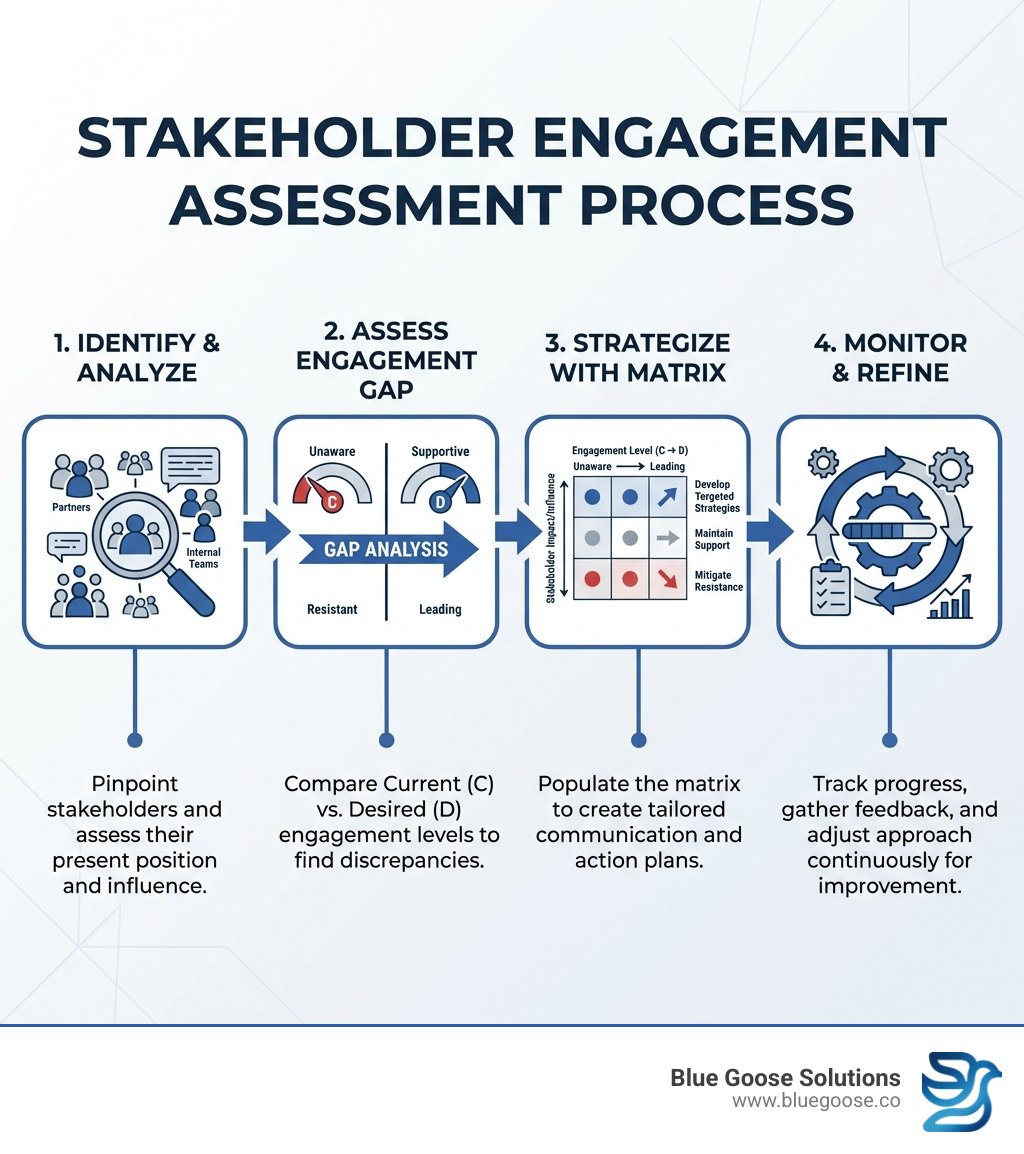
How to Create and Use the Engagement Assessment Matrix in 4 Steps
Creating and using an engagement assessment matrix is a dynamic process, not a static exercise. It is an actionable guide that evolves throughout your project lifecycle, helping you adapt your strategies as stakeholder dynamics shift. For purpose-driven organizations, this adaptability is key to navigating complex community landscapes and political environments. If you want to learn more about our approach to strategic engagement, you can find More info about our approach.

Step 1: Identify Stakeholders and Analyze Their Position
First, identify everyone with a stake in your project. This includes direct stakeholders like sponsors and team members, plus indirect ones like community groups, regulators, and funders. You can use a combination of:
- Brainstorming sessions: Gather your project team to list everyone who might be affected by or able to affect your project.
- Interviews: Talk to key individuals to understand their perspectives and identify other potential stakeholders.
- Document review: Examine project charters, organizational charts, and previous project records to uncover relevant parties.
Once identified, analyze their position. This involves understanding their interests, influence, and potential impact. A common tool for this initial analysis is the Power-Interest Matrix. This matrix categorizes stakeholders based on two variables: their power (ability to influence the project) and their interest (how much they care about the project's outcome). This helps you prioritize your efforts:
- High Power, High Interest: These are key players, requiring active management and close engagement.
- High Power, Low Interest: Keep these stakeholders satisfied to prevent them from becoming an obstacle.
- Low Power, High Interest: Keep these stakeholders informed, as their collective voice or individual passion can grow.
- Low Power, Low Interest: These stakeholders typically require minimal monitoring.
This initial analysis helps determine who needs attention and how to engage them, making this foundational step crucial for success.
Step 2: Determine 'Current' (C) and 'Desired' (D) Engagement
With stakeholders identified and their general influence understood, the next step is to assess their current engagement level (C) and define their desired engagement level (D). This is where the core of the engagement assessment matrix begins to take shape.
To determine the "Current" (C) level, you can use several assessment techniques:
- Observation: Pay attention to how stakeholders participate in meetings, their responsiveness to communications, and their overall attitude toward the project.
- Direct Feedback: Engage in one-on-one conversations, conduct informal surveys, or hold focus groups to gather their opinions and concerns.
- Review of Past Interactions: Look at communication logs, meeting minutes, and feedback forms from previous project phases or related initiatives.
The "Desired" (D) level is determined based on what each stakeholder needs to contribute to the project's success. This is not about wishing for everyone to be "Leading"; it is about setting realistic and strategic goals. For instance, a regulatory body might only need to be "Supportive" in its approval process, while a key funding partner may need to be "Leading" to actively champion fundraising efforts. You can determine these desired levels by considering:
- Stakeholder Needs and Expectations: What do they require from the project, and what do they expect in return?
- Interests: How does the project align with their core interests?
- Potential Impact: How much impact can they have on the project's success if they are at a particular engagement level?
- Project Success Criteria: How does their engagement directly contribute to your project's objectives?
Aligning these desired levels with your project's success criteria ensures that engagement efforts are purposeful and directly support your mission.
Step 3: Populate the Matrix and Develop Your Strategy
Once you have identified stakeholders and determined their current (C) and desired (D) engagement levels, populate the engagement assessment matrix. Set up a table where each row represents a stakeholder and the columns represent the five engagement levels (Unaware, Resistant, Neutral, Supportive, Leading). For each stakeholder, mark their "C" in the appropriate column and their "D" in the desired column.
This visualization immediately highlights engagement gaps. For example, if a key community leader is "Neutral" (C) but needs to be "Leading" (D) for a new community center project in Alexandria VA, you have a clear, significant gap to address.
Now, use this insight to develop your engagement strategy:
- Tailoring Communication: For "Unaware" stakeholders, focus on awareness campaigns. For "Resistant" ones, address concerns in one-on-one meetings. For "Supportive" stakeholders, maintain enthusiasm with regular updates and opportunities for input.
- Resource Allocation: The matrix helps you allocate time and resources efficiently. Devote more effort to stakeholders with large gaps or those whose engagement is critical for project success.
- Overcoming Resistance: For resistant stakeholders, be proactive. Involve them in problem-solving, find common ground, and address conflicts constructively to turn opposition into dialogue.
- Building Support: For those who are neutral or supportive, focus on nurturing the relationship, providing opportunities to contribute, and, when appropriate, turning them into active champions for your mission.
This step turns your assessment into action, guiding project teams in Washington DC or Fort Washington to engage with precision.
Step 4: Monitor, Update, and Refine
The engagement assessment matrix is not a set-it-and-forget-it tool. It is a living document that requires continuous monitoring, updating, and refinement. Stakeholder dynamics are fluid; people's opinions, priorities, and levels of influence can change throughout a project's lifecycle.
Useful practices include:
- Ongoing Process: Treat stakeholder engagement as a dynamic and ongoing process. Just as you track project progress, track engagement progress.
- Regular Reviews: Schedule regular reviews of the matrix—quarterly, at major project milestones, or during significant changes to the project scope or environment. This helps you catch shifts early and adapt strategies.
- Adapting to Change: If a stakeholder moves from "Neutral" to "Resistant," work to understand why and adjust your approach. Conversely, if efforts successfully move someone from "Resistant" to "Supportive," update the matrix and note that progress.
- Communication Plan Adjustments: Any changes in stakeholder engagement should prompt a review and potential adjustment of the communication plan. This helps keep messaging relevant and effective.
- Reporting Progress: The updated matrix can be a useful tool for reporting progress to project sponsors and leadership, demonstrating how you are actively managing relationships crucial to your mission's success.
By continuously monitoring and updating your engagement assessment matrix, you help ensure that engagement strategies remain agile and responsive, supporting lasting backing for your purpose-driven work.
Benefits, Limitations, and Overcoming Challenges
The engagement assessment matrix offers significant strategic value for many projects, particularly for purpose-driven organizations where community and stakeholder trust are paramount. It supports a balanced perspective, allowing teams to proactively manage relationships rather than react only when problems surface. For more insights on engagement, you can explore Our insights on engagement.
Why Effective Stakeholder Engagement Matters
Effective stakeholder engagement is not just a best practice; it is a cornerstone of project success. For organizations working in communities like Oxon Hill, Maryland, or Alexandria VA, it can be the difference between a project that flounders and one that flourishes.
- Builds Trust and Credibility: Transparent and consistent engagement fosters trust, which is invaluable for long-term relationships and future collaborations. When stakeholders feel heard and involved, they are more likely to trust your intentions and actions.
- Mitigates Risk Early: By actively engaging stakeholders, you can identify potential risks, concerns, or opposition early in the project lifecycle. This allows you to address issues proactively, preventing them from escalating into major obstacles. Research shows that early stakeholder involvement in complex projects can improve outcomes. You can read more about this in this one research paper.
- Improves Decision-Making: Diverse stakeholder perspectives bring a range of knowledge and insights. Engaging them can improve the quality of decisions, leading to more robust and widely accepted project outcomes.
- Improves Communication: A structured approach to engagement supports clear, consistent, and custom communication, reducing misunderstandings and building a shared vision.
- Increases Project Success: Effective stakeholder engagement helps ensure that stakeholder needs and expectations are considered, leading to smoother execution and greater impact.
- Fosters Long-Term Relationships: Beyond a single project, successful engagement can build enduring relationships that benefit an organization's mission for years to come.
Understanding the Limitations and Common Challenges
While the engagement assessment matrix is a useful tool, it is important to understand its limitations and the challenges it may present:
- Subjectivity: Assigning engagement levels can be subjective. What one project manager considers "Supportive," another might view as "Neutral." This highlights the importance of team consensus and clear definitions.
- Oversimplification: The matrix, by design, provides a snapshot of engagement. It can be oversimplified, offering only one-dimensional insights into complex relationships. It does not always capture the nuances of stakeholder relationships, their underlying interests, or their full impact.
- Static if Not Updated: If the matrix is not regularly monitored and updated, it quickly becomes outdated and less useful. Stakeholder dynamics change, and a static matrix can lead to misinformed strategies.
- Conflicting Interests: Projects often involve stakeholders with conflicting interests. The matrix helps identify these, but it does not resolve them. Managing such conflicts requires additional negotiation and facilitation skills.
- Managing Resistance: While the matrix highlights resistant stakeholders, moving them to a more supportive position can require significant effort, patience, and strategic communication.
- Limited Project Manager Time and Resources: A common challenge in stakeholder management is the limitation on a project manager's knowledge, skills, and time when it comes to analyzing all relevant stakeholders. As noted in this study, a comprehensive stakeholder analysis is foundational, but it demands sustained attention.
Complementary Tools for a Holistic View
To address some of the limitations of the engagement assessment matrix and gain a more complete understanding of stakeholders, it can help to combine it with other analytical tools:
- Sentiment Analysis: Beyond simple labels like "Supportive" or "Resistant," sentiment analysis helps you gauge the emotional tone of stakeholder communications. This can be done through surveys, manual qualitative analysis of feedback, or automated tools for larger datasets. Tracking sentiment changes over time can provide insight into the effect of engagement activities.
- Stakeholder Relationship Mapping: This involves visualizing the connections and relationships between stakeholders. Understanding these networks can reveal hidden influencers, potential allies, or areas of conflict that a simple matrix might miss. It helps you see who talks to whom and the strength of those connections.
- RACI Matrix: This matrix clarifies roles and responsibilities for specific tasks or decisions, designating who is Responsible, Accountable, Consulted, and Informed. While not directly an engagement assessment tool, it supports clarity in how stakeholders are involved in project activities.
- Salience Model: This model categorizes stakeholders based on their power, legitimacy, and urgency. It helps prioritize stakeholders who are most salient (important) to the project, offering a deeper layer of analysis than just power and interest.
By using these tools in combination, you can build a more comprehensive picture of your stakeholder landscape and design strategies that reflect the complexity of the missions your organization aims to advance.
Frequently Asked Questions about the Engagement Assessment Matrix
How does the engagement assessment matrix differ from a Power/Interest Grid?
The Power/Interest Grid is primarily an initial analysis and prioritization tool. It categorizes stakeholders based on their level of power (influence) and interest in a project, helping us determine how to manage them (e.g., actively manage, keep satisfied, keep informed, monitor). It's a foundational step to understand who matters most and what general communication approach to take.
The engagement assessment matrix, on the other hand, focuses on the actual and desired levels of support and involvement for the project. While it uses the insights from a Power/Interest Grid to identify key stakeholders, its purpose is to track their current emotional and active stance (Unaware, Resistant, Neutral, Supportive, Leading) and plan specific interventions to move them towards a desired engagement level. It's more about ongoing management and closing specific gaps in their buy-in.
When is the best time to assess stakeholder engagement?
Assessment is not a one-time event; it's an ongoing process throughout the project lifecycle.
- Project Kickoff/Planning Phase: This is the ideal time for the initial assessment. We identify all stakeholders, analyze their positions (using tools like the Power/Interest Grid), and determine their current and desired engagement levels. This informs our initial stakeholder engagement plan.
- Periodic Reviews and Updates: We should revisit the engagement assessment matrix regularly—for example, quarterly or at significant project milestones. This allows us to monitor changes in stakeholder dynamics, assess the effectiveness of our engagement strategies, and make necessary adjustments.
- During Major Changes or Crises: Any significant shift in project scope, budget, timeline, or external environment warrants an immediate re-assessment of stakeholder engagement. This helps us anticipate reactions and adapt our communication and engagement plans proactively.
- Project End: A final assessment can help evaluate the overall effectiveness of our stakeholder management efforts and inform future projects.
Regular assessment ensures our strategies remain relevant and responsive to the evolving needs and attitudes of our stakeholders.
How do you manage a resistant but powerful stakeholder?
Managing a resistant but powerful stakeholder is one of the most challenging, yet critical, tasks in project management. Here's our approach:
- Address Their Concerns Directly and Transparently: Avoidance only exacerbates resistance. Schedule direct, one-on-one meetings to understand their perspective fully. Listen actively without interrupting and acknowledge their concerns, even if you don't immediately agree.
- Seek to Understand the Root Cause of Their Resistance: Is it fear of change? A perceived threat to their interests? A lack of understanding? Past negative experiences? Dig deeper to uncover the underlying reasons, as these often hold the key to resolution.
- Involve Them in Problem-Solving: If possible, invite them to contribute to solutions or be part of a working group addressing the issue. When powerful stakeholders feel included in the decision-making process, their resistance often diminishes, and they may even become advocates.
- Find Common Ground: Identify shared objectives or mutual benefits. Even if they resist a specific aspect of the project, there might be overarching goals that align with their interests. Frame the project in terms of these shared benefits.
- Demonstrate How the Project Aligns with Their Interests or Mitigates Their Risks: Show them how the project can actually benefit them or minimize any negative impacts they foresee. Provide data, case studies, or pilot results if available.
- Be Flexible (Where Possible): While maintaining project integrity, be open to adjusting minor aspects of the plan if it significantly alleviates a powerful stakeholder's concerns without compromising core objectives. This shows a willingness to collaborate.
This approach requires patience, empathy, and strong communication skills, but changing a powerful resistant stakeholder into a neutral or even supportive one can be a game-changer for project success.
Conclusion: Driving Your Mission with Strategic Engagement
The engagement assessment matrix is more than just a chart; it's a vital tool for purpose-driven organizations like ours, helping us steer the complex human landscape of our projects. From clarifying our messages to building unwavering support, this framework empowers us to move beyond assumptions and engage with precision.
We've explored its definition, dissected its components, walked through the steps of its creation and use, and acknowledged both its immense benefits and practical limitations. We've seen how, by identifying where stakeholders currently stand and where we need them to be, we can strategically tailor our efforts, mitigate risks, and foster the trust essential for long-term success.
For mission-based teams, whether you're working on community initiatives in Oxon Hill, public programs in Washington DC, or non-profit campaigns in Alexandria VA, effective stakeholder engagement is the bedrock of impact. The engagement assessment matrix provides the roadmap, but it's our dedication to understanding, communicating with, and involving our stakeholders that truly brings our missions to life.
At Blue Goose Solutions, we specialize in helping mission-based teams clarify their messages, grow their reach, and build the support necessary to achieve their goals. The principles of the engagement assessment matrix are woven into our strategic coaching and full-scale implementation services. To learn more about how we help purpose-driven organizations succeed, visit Learn how we help mission-based teams succeed.
