
Click for Good: Unveiling the Best Nonprofit Website Designs
Why Your Nonprofit Website Is Your Most Powerful Tool
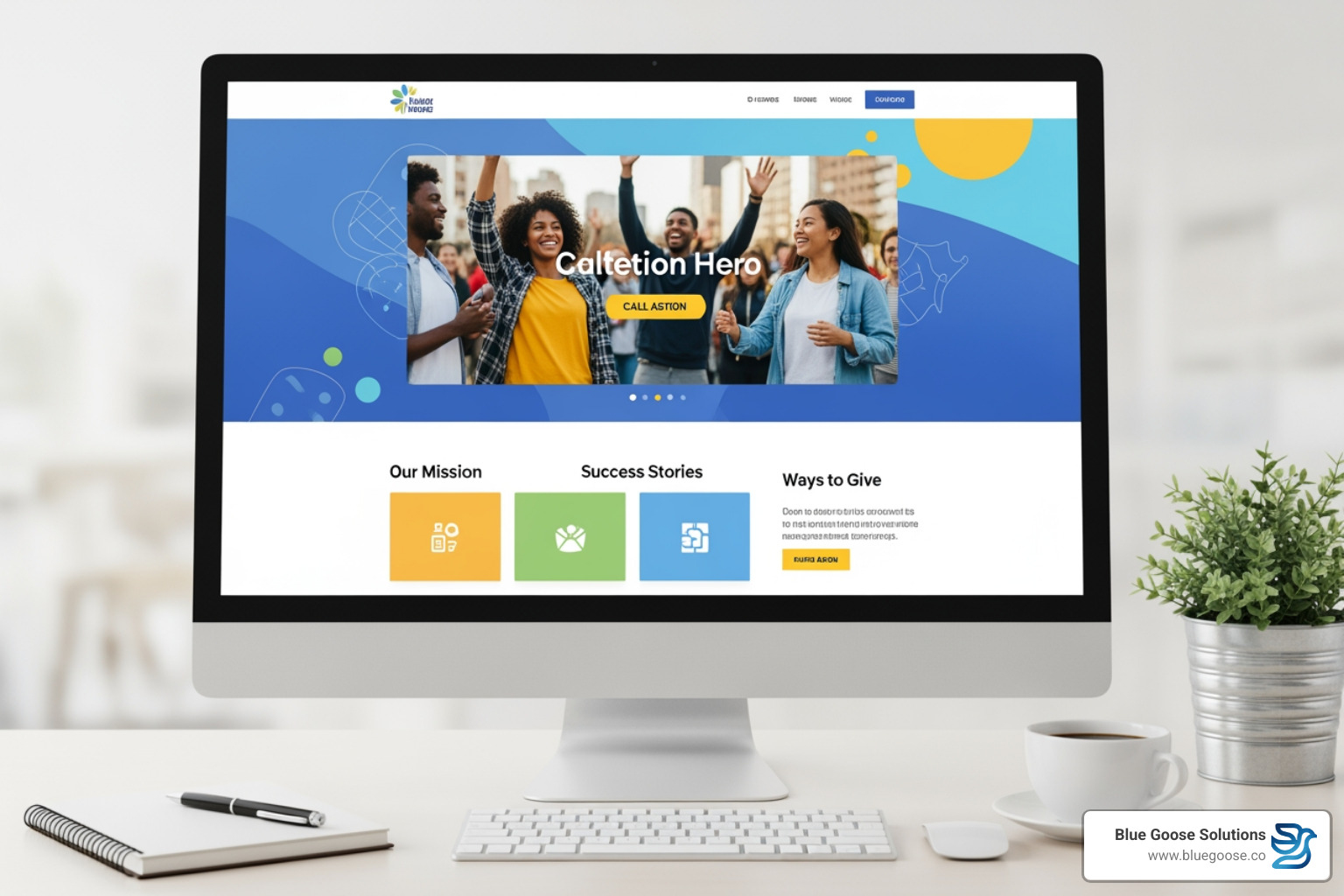
Nonprofit website design is more than aesthetics—it's the digital foundation that determines whether visitors become donors, volunteers, or advocates for your cause. Here's what makes a nonprofit website truly effective:
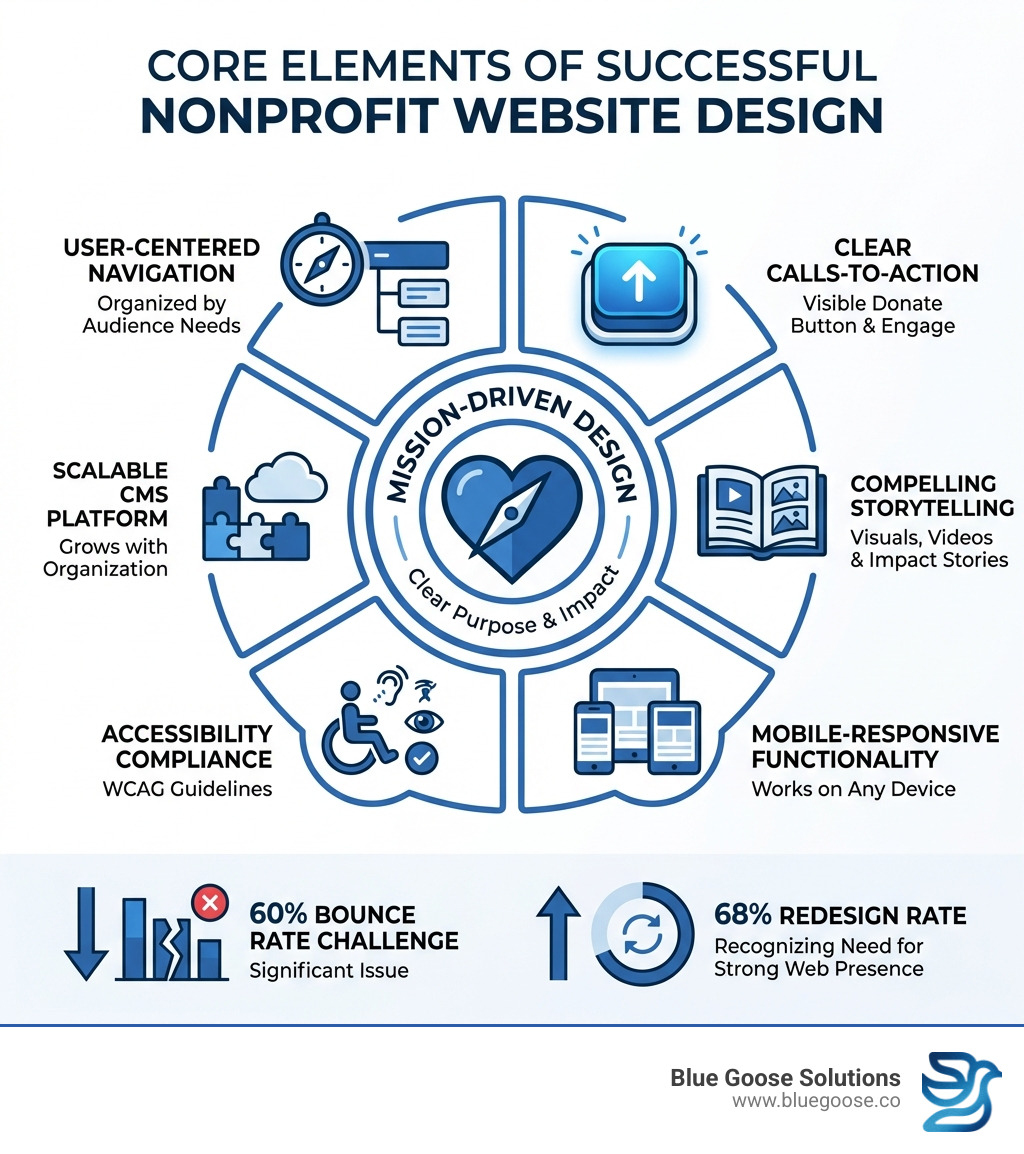
Essential Elements:
- Mission-driven design that clearly communicates your purpose
- User-centered navigation organized by audience needs (donors, volunteers, beneficiaries)
- Prominent calls-to-action including a visible donate button
- Compelling storytelling through visuals, videos, and impact stories
- Mobile-responsive design that works on any device
- Accessibility compliance following WCAG guidelines
- Scalable platform (like WordPress or Drupal) that grows with your organization
The stakes are high. Nonprofit websites face bounce rates around 60%—significantly higher than the 40% average for other websites. Yet 68% of nonprofits have redesigned their websites in the past three years, recognizing that a strong web presence is no longer optional. As online giving surpasses direct mail for most organizations, your website has become the primary gateway to support.
I'm Jason R.L Wallace, Chief Marketing Officer at Blue Goose Solutions, where I help mission-driven organizations build digital experiences that drive real impact. My work spans strategic engagement for the National Institutes of Health, community programs serving 18,000+ volunteers annually, and national marketing initiatives with multimillion-dollar budgets—all centered on translating mission into measurable results through effective nonprofit website design. Throughout this guide, I'll show you real-world examples of websites that inspire action and walk you through the exact process to create your own.
The Blueprint for Impact: Essential Elements of a Great Nonprofit Website
A successful nonprofit website isn't just a digital brochure; it's a dynamic hub designed to inform, engage, and inspire. These foundational principles turn a standard site into a powerful tool for change, addressing how to balance your mission with seamless usability.
The Core: Mission-Driven Design and User-Friendly Functionality
At the heart of every great nonprofit website design is a clear, unwavering commitment to its mission. Your website should put your purpose front and center, ensuring that every visitor immediately understands what your organization stands for and why it matters. This isn't just about placing your mission statement prominently; it's about infusing it into every design choice, every piece of content, and every interaction.
Crucially, this mission-driven approach must be paired with user-friendly functionality. An admirable mission alone isn’t enough to catch potential online donors’ attention. To stand out, organizations must make sure their websites provide a positive, user-friendly experience for visitors. This means focusing on user experience (UX) to ensure visitors can easily find what they need, whether they're seeking information, looking to donate, or wanting to volunteer.
Consistent branding is also paramount. Your logo, color palette, fonts, mission statement, boilerplate copy, and even your voice and tone should be unified across your entire site. This builds recognition and trust, making your organization feel professional and reliable. For instance, branded donation forms typically receive seven times the donations of non-branded forms, underscoring the power of consistent branding.
The goal is to create an emotional connection. Compelling images, storytelling copy, appropriate color schemes, and sharing success stories can all contribute to this. When visitors feel connected to your cause, they are more motivated to act. The balance between communicating your profound purpose and providing a smooth, intuitive user experience is what transforms a good nonprofit website into a great one.
We believe that thoughtful web design and strategy can turn a website into a powerful tool for change, connecting with hearts and inspiring action. For more insights into how we approach this balance, read our article on Nonprofit Marketing: Separating Fact From Fiction.
Inspiring Action: User-Centered Navigation and Clear CTAs
Imagine a potential supporter landing on your website, eager to help, but unable to figure out how. Frustrating, right? User-centered navigation is all about making it incredibly easy for visitors to find exactly what they're looking for, guiding them effortlessly through your site. This often involves organizing navigation menus by key audience channels, such as sections specifically for donors, volunteers, or those seeking services. This strategic audience segmentation ensures that pathways to action are clear and direct for everyone.
Clear calls-to-action (CTAs) are the signposts that convert interest into tangible support. These aren't just generic buttons; they are urgent, compelling invitations to engage. A prominent "Donate" button, for example, is essential. It should be placed in a highly visible location, often the top-right corner of your primary navigation, and use contrasting, accessible colors to stand out. Studies show that a convenient, inspirational donation page is the centerpiece of your nonprofit’s website, and donation buttons should be prominently placed across all pages to encourage immediate action.
Beyond donations, consider other key actions:
- Volunteer Sign-Ups: If you host volunteer events, integrating scheduling platforms directly into your site can streamline the process, allowing visitors to view availability and sign up without ever leaving the page.
- Email Newsletter Forms: These are vital for building ongoing relationships, capturing contact information so you can continue to share updates and deepen engagement over time.
- Advocacy Actions: For organizations focused on policy change or awareness, clear CTAs for signing petitions or contacting elected officials are crucial.
The International OCD Foundation, for instance, uses CTAs that emphasize three primary actions: finding help, learning more about OCD, and getting involved. This multi-faceted approach caters to diverse visitor needs while driving engagement. Mercy Corps, another great example, features compelling landing pages, like a matching gift page, which encourages visitors to double their impact through workplace giving. By making these actions easy and obvious, you empower your audience to become active participants in your mission.
Future-Proofing Your Mission: Accessibility and Scalable Nonprofit Website Design
In today's digital landscape, a successful nonprofit website design must be built not just for today's users, but for everyone, and for tomorrow's growth. This means prioritizing accessibility and scalability from the very beginning.
Accessibility ensures that your website is usable by the broadest possible audience, including individuals with disabilities. This isn't merely a "nice-to-have" feature; in many cases, legal regulations like the Americans with Disabilities Act (ADA) require websites to be accessible to all visitors. Adhering to the Web Content Accessibility Guidelines (WCAG), particularly Level AA standards, is crucial. This includes features like alternative text for images, sufficient color contrast, logical headings, and keyboard navigation. Shockingly, only 22% of nonprofits have websites designed for people with visual or hearing disabilities, highlighting a significant gap and an opportunity to reach a wider audience and better serve beneficiaries. By making your site accessible, you build trust, improve your credibility, and embody the inclusive values central to most nonprofit missions.
Scalability, on the other hand, means designing your website so it can grow and adapt as your organization evolves. Your mission doesn't stand still, and neither should your digital presence.
- Mobile-First Design: With over 60% of Google searches happening on mobile devices, a mobile-first approach is non-negotiable. Your site must be responsive, displaying correctly and functioning seamlessly on smartphones, tablets, and desktops alike. This ensures a consistent and positive user experience across all devices.
- Content Management System (CMS): Choosing a robust and flexible CMS, such as WordPress (which powers over 42% of the web) or Drupal, is key. Scalable CMS platforms empower your team to streamline content updates, add new programs, and improve engagement without needing a web developer for every small change. This adaptability allows you to empower local teams to quickly add updates and share information, keeping program content fresh and accurate.
- Planning for Growth: When we design websites at Blue Goose, we consider future needs. Will you be adding new programs, expanding to new regions, or engaging with more diverse audiences? Your website should be built on a foundation that can handle increased traffic, more content, and new functionalities without requiring a complete overhaul every few years. This strategic foresight saves time, resources, and ensures your digital home remains a powerful asset for your mission for years to come.
Showcase: 10 Nonprofit Website Designs That Inspire Action
We've talked about the theory; now let's dive into practice. These standout examples masterfully combine compelling design with clear, mission-focused goals, demonstrating how effective nonprofit website design can truly drive impact and inspire action.
1. Charity: Water
Why it stands out: Charity: Water masterfully combines powerful storytelling with radical transparency. Their website isn't just about asking for donations; it's about showing you the tangible impact of every dollar. They use powerful videos, photos, and personal narratives to create an emotional connection, making visitors feel like a direct part of the solution. Their innovative donation tracking tools build immense trust, allowing supporters to see exactly where their money goes and the lives it changes. This blend of emotional appeal and clear impact reporting is incredibly effective at inspiring global action.
2. World Wildlife Fund (WWF)

Why it stands out: WWF's website successfully balances emotional appeal with strong functionality, connecting supporters to global conservation efforts. Their immersive imagery of stunning wildlife grabs attention and immediately drives home their mission. Engaging calls-to-action, such as "Adopt an Animal" and "Take Action," are strategically placed, making it easy for visitors to participate in their work. The site's clean organization and intuitive layout ensure that users can steer effortlessly, whether they want to learn about specific species or contribute to a campaign.
3. Feeding America
Why it stands out: Feeding America excels at using data and visuals to highlight its nationwide mission to combat hunger. Their website features impact-driven statistics and eye-catching visuals that showcase the organization’s tangible results, making their vast work feel immediate and understandable. The streamlined donation process and user-friendly functionality simplify the donor experience, removing barriers to giving. By pairing compelling data with real-world impact, they make a clear case for support and inspire contributions.
4. The Malala Fund
Why it stands out: The Malala Fund's website is a powerful example of bold design and clear advocacy. It immediately communicates its mission to help girls pursue secondary education worldwide, supporting education advocates and activists. The site's strong brand voice and focus on advocacy are evident throughout, using compelling imagery and direct language to engage visitors. It connects supporters to a global network, fostering a sense of collective action and empowering individuals to contribute to a crucial cause.
5. Doctors Without Borders
Why it stands out: Doctors Without Borders employs a clear, mission-first approach to connect with supporters and share critical updates from the field. Their website uses urgent calls-to-action, with donation buttons prominently placed across all pages, encouraging visitors to act immediately. By sharing timely stories and field reports, they provide valuable insights into ongoing humanitarian efforts, building trust and encouraging ongoing donor engagement. This direct, impactful communication resonates deeply with visitors.
6. The Trevor Project
Why it stands out: The Trevor Project's website is a masterclass in providing crisis support through clear, accessible design. For a nonprofit focused on suicide prevention and crisis intervention for LGBTQ young people, creating a safe, intuitive digital space is paramount. The site prominently features a "Get Help" button that is instantly recognizable and accessible from every page, linking to various support channels. Its calming color palette, empathetic language, and easy-to-steer resources ensure that youth in crisis can find help quickly and discreetly, making it a lifeline for its beneficiaries.
7. St. Jude Children’s Research Hospital
St. Jude Children’s Research Hospital
Why it stands out: St. Jude Children’s Research Hospital's website is incredibly effective at sharing powerful impact stories, focusing on the children and families they serve. The site transparently communicates how funds are used to research, treat, and ultimately defeat childhood cancer, covering costs for treatment, travel, housing, and food. Through compelling patient narratives and a clear presentation of their mission, they create a strong emotional connection, showcasing multiple ways to give and inspiring profound generosity.
8. Girls Who Code
Why it stands out: Girls Who Code uses vibrant branding and clear program information to engage and inspire. Their website effectively communicates their mission to close the gender gap in technology by engaging and training girls in computer science. The site features compelling success stories of girls who have participated in their summer camps, clubs, and college prep programs. Its accessible layout and engaging content make it easy for girls, parents, and educators to understand and get involved in their initiatives.
9. The Humane League
Why it stands out: The Humane League's website is action-oriented and uses strong visuals to advance its advocacy goals. Dedicated to ending the abuse of animals raised for food production, the site clearly outlines their campaigns and provides concrete ways for visitors to take action. High accessibility standards ensure that their message reaches a broad audience, and their clear calls for engagement drive supporters to participate in their advocacy efforts, making it a powerful tool for social change.
10. Gakino’amaage: Teach for Canada
Gakino’amaage: Teach for Canada website
Why it stands out: The Gakino’amaage: Teach for Canada website is an exemplary resource for its inclusivity, strategically chosen audiences, and effective branding practices. Their branding is inspired by various First Nations art forms and common symbols, immediately conveying a deep respect for the communities they serve. Incorporating messaging in three languages (Ojibwe, English, and French) reflects linguistic diversity and inclusivity. Organizing navigation menus by key audience channels (educators, communities, supporters) facilitates quick action pathways, making it easy for diverse users to find relevant information and engage with their mission to make education more equal across Canada.
From Vision to Reality: A 7-Step Guide to Your Nonprofit Website Design Project
Bringing your vision to life with a powerful nonprofit website design requires a clear, structured process. We've refined these seven key stages to help you steer the journey, ensuring your new digital home is not only beautiful but also highly effective and sustainable.
Findy & Goal Setting: This crucial first step involves outlining the parameters of your website. We work with you to define your core goals, such as increasing online donations, recruiting volunteers, educating the public, or providing services to beneficiaries. We'll identify your target audiences—clients, donors, volunteers—and interview them to understand their specific needs. This stage also includes establishing a realistic budget and timeline, and setting SMART (Specific, Measurable, Attainable, Relevant, Time-bound) goals to track progress effectively.
Structure & Wireframing: Once goals are clear, we map out your website's architecture. This involves creating wireframes, which are like blueprints for your site. Wireframes illustrate the layout and functionality of each page without focusing on detailed appearance. This ensures logical structure and user-centered navigation, making sure visitors can easily find what they need. This is also where we plan your primary navigation, ensuring essential categories like "About Us," "Our Work," and "Get Involved" are intuitively placed, often with a prominent "Donate" button.
Content Strategy & Storytelling: A great website needs compelling content. This stage focuses on developing a robust content strategy, including planning for storytelling through impact stories, high-quality visuals, and video testimonials. We'll determine the types of content needed (blog posts, program descriptions, annual reports) and how they'll be organized. This is also where we consider search engine optimization (SEO) by identifying relevant keywords to integrate into your content, helping potential supporters find you through search engines.
Visual Design & Branding: This is where your website starts to come alive visually. Based on the wireframes and content strategy, our designers create a visual theme that aligns perfectly with your nonprofit’s branding guidelines. This includes selecting color palettes, typography, imagery, and interactive elements that evoke emotion and reinforce your mission. The goal is to create an aesthetically pleasing design that is consistent throughout all pages and resonates with your audience.
Development & Integration: With the design approved, our developers get to work building the site. This involves coding the website, integrating your chosen Content Management System (CMS) like WordPress or Drupal, and connecting any necessary third-party tools such as donation platforms, email marketing services, or volunteer management systems. We ensure the site is built on a scalable foundation, capable of growing with your organization, and that it adheres to modern web standards for performance and security.
Testing & Quality Assurance: Before launch, rigorous testing is essential. We carefully test every aspect of your website, from functionality and user experience to mobile responsiveness and accessibility. This includes checking all links, forms, and interactive elements, ensuring the site displays correctly across different browsers and devices, and verifying WCAG compliance. This stage guarantees a smooth, error-free experience for all users.
Launch & Ongoing Optimization: The big day! We launch your new website, making it live for the world to see. But our work doesn't stop there. We provide ongoing support and work with you to monitor performance, analyze user behavior through analytics, and make continuous improvements. This iterative process of optimization ensures your website remains effective, up-to-date, and continually serving your mission.
We understand that a successful website is a powerful tool for advocacy. Learn more about how we can help amplify your message with Digital Advocacy Campaigns.
Frequently Asked Questions
How can a nonprofit website effectively tell its story and inspire action?
A nonprofit website's unique power lies in its ability to tell compelling stories that forge an emotional connection with visitors, changing passive viewers into active supporters. Here's how we ensure your website tells your story effectively and inspires action:
- Focus on Impact Stories: Instead of just stating your mission, show it in action. Feature stories of beneficiaries whose lives have been changed by your work. Personal narratives are incredibly powerful.
- High-Quality Visuals and Video Testimonials: A picture is worth a thousand words, and a video can be worth even more. Use captivating images and videos that showcase your work and the people you help. Video testimonials from beneficiaries, volunteers, or even staff can create a profound emotional resonance.
- Connect Donations to Outcomes: Transparency is key. Show visitors exactly what their contributions achieve. Charity: Water, for example, excels at donation tracking, allowing donors to see the tangible impact of their gifts. This builds trust and reinforces the value of their support.
- Clear Calls-to-Action within Stories: Don't just tell a story; use it as a springboard for action. Integrate clear and compelling calls-to-action directly within or immediately following impact stories, guiding visitors on how they can contribute to similar outcomes.
- Highlight the "Why": Continuously reinforce the problem your organization is solving and the positive change you are creating. This "why" motivates people to get involved.
- Transparent Reporting: Make annual reports and financial statements easily accessible. Showcasing impact with Annual Report Design can also be a powerful storytelling tool, demonstrating accountability and the effective use of resources.
What are the best practices for creating and managing website content?
Effective content is the lifeblood of your nonprofit website, keeping it fresh, relevant, and engaging for your audience and search engines alike. Here are our best practices for creating and managing it:
- Regularly Updated Blog: A blog is an excellent place to share news, updates, organizational milestones, event recaps, and thought leadership pieces. Consistent posting signals to search engines that your site is active and provides fresh content for your audience.
- Evergreen Resources: Develop content that remains relevant over time, such as guides, FAQs, or educational resources related to your cause. This "evergreen" content can consistently attract visitors searching for information, providing long-term value.
- SEO Best Practices: Integrate relevant keywords naturally into your content, write compelling title tags and meta descriptions, and use clear headings to structure your pages. This helps search engines understand your content and rank it higher in search results, increasing your visibility without relying solely on paid advertising.
- Clear Calls-to-Action: Every piece of content should have a purpose. Include clear CTAs that guide readers to the next step, whether it's donating, volunteering, signing up for a newsletter, or learning more about a specific program.
- Visuals and Multimedia: Break up text with engaging images, infographics, and videos. Visuals make content more digestible and appealing, enhancing the user experience.
- Content Calendar: Plan your content in advance using a content calendar. This ensures a consistent flow of fresh material and helps align your content with campaigns, events, and fundraising efforts.
- User-Generated Content: Encourage testimonials and stories from your beneficiaries and volunteers. This authentic content builds trust and adds a powerful, human element to your website.
Why is accessibility so important in nonprofit website design?
Accessibility is a cornerstone of responsible and effective nonprofit website design. It's about ensuring that everyone, regardless of their abilities, can access and interact with your digital content. Its importance cannot be overstated:
- Inclusivity for All Users: Nonprofits are inherently about serving communities. By designing for accessibility, you ensure that your website is inclusive, allowing people with visual impairments (using screen readers), hearing impairments (with captions for videos), motor disabilities (using keyboard navigation), and cognitive disabilities to fully engage with your mission.
- Serving Beneficiaries: Many nonprofits directly serve individuals with disabilities. An inaccessible website can create significant barriers for those who need your services most, undermining your core mission.
- Legal Requirements: In many regions, including the United States, web accessibility is a legal mandate. The Americans with Disabilities Act (ADA) requires public-facing websites to be accessible. Non-compliance can lead to legal challenges, reputational damage, and costly remediation.
- Building Trust and Credibility: An accessible website demonstrates your organization's commitment to equity and respect for all individuals. This builds trust with your audience, including donors, volunteers, and partners, enhancing your credibility and reputation.
- Reaching a Wider Audience: By removing barriers, you expand your potential reach. This means more donors, more volunteers, and more people who can benefit from your services. It's a strategic advantage that allows your message to resonate with a broader demographic.
- Improved User Experience for Everyone: Many accessibility features, such as clear navigation, good color contrast, and well-structured content, benefit all users, not just those with disabilities. A website that's easy for everyone to use is simply a better website.
We adhere to Web Content Accessibility Guidelines (WCAG) to ensure our clients' websites meet Level AA standards, making them usable and welcoming for everyone.
Conclusion
A strategic, well-executed website is your nonprofit's most powerful asset for growing your reach and deepening your impact. By focusing on mission-driven design, user experience, and compelling storytelling, you can create a digital home that inspires visitors to become lifelong supporters. The examples we've explored demonstrate that with thoughtful planning and execution, your website can be a vibrant testament to your work, capable of converting casual visitors into passionate advocates.
At Blue Goose, with our roots in the Washington DC metropolitan area, including Oxon Hill, Maryland, Alexandria, VA, and Fort Washington, we specialize in helping purpose-driven organizations translate their mission into powerful digital experiences. We understand the unique challenges and opportunities nonprofits face, offering flexible support from strategic coaching to full-scale implementation. Ready to transform your digital presence and make your website a true force for good? Learn more in our complete guide to Nonprofit Marketing: Separating Fact From Fiction.
